



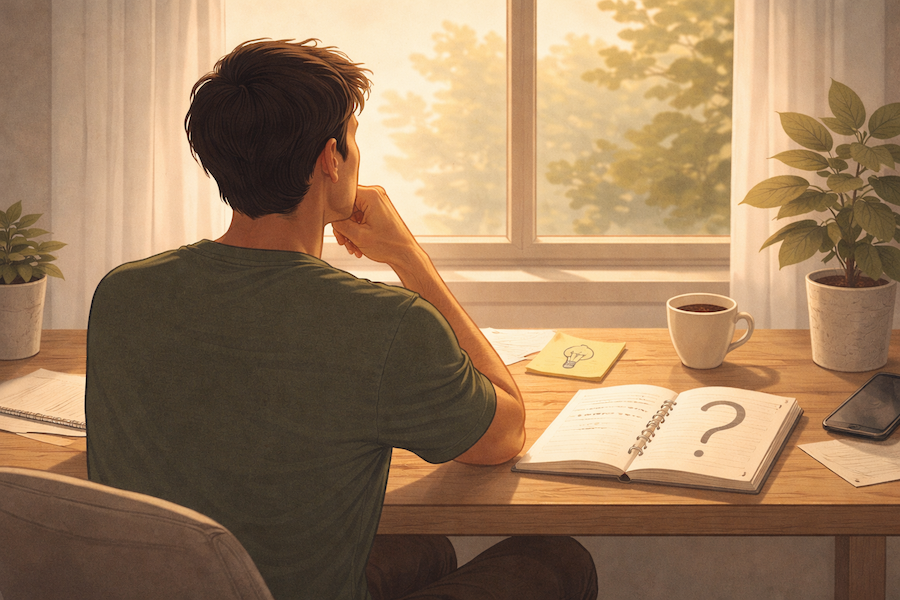
Why some ideas keep coming back to our mind
Some ideas appear and disappear without leaving a trace.
Others, however, come back.
They do not return loudly or urgently.
They simply reappear again and again, at different moments.
A thought that resurfaces after a few days.
A possibility that is never fully dismissed.
A question that remains, even when it is not answered.
When an idea keeps returning, it is not random.
Not because it is an external sign, but because something internal has not been resolved yet.
Most ideas don’t repeat, and that’s why it matters when one does
Throughout the day, the brain generates dozens of thoughts.
Most of them fade quickly. They do not fit the moment, they do not connect with a real need, or they do not have room to develop.
But some ideas do not follow that path.
They get archived.
They stay in the background.
And they return when the mental context allows it.
Repetition does not make an idea correct, but it does make it relevant.
Repetition isn’t obsession, it’s processing
There is a clear difference between obsession and repetition.
Obsession is closed, tense, and circular.
It tries to force resolution through anxiety.
Repetition, by contrast, is open.
The idea comes back, it is observed, and then it is allowed to pass again.
There is no urgency to decide, only a need to understand.
When someone is in a phase of openness, as often happens at the beginning of a year, the brain needs time to process new possibilities.
And that processing is not linear.
It is intermittent.
That is why some ideas do not resolve all at once.
They repeat until they either find their place, or are truly let go.
“Why, when we think about changing, the mind starts looking for confirmation”
This different way of thinking is reminiscent of what we explored in Why January Is Full of Possibilities, where mental context opens doors to thoughts that were previously dismissed.”
Why repeated ideas start to feel possible
Every time an idea returns, the brain does something important. It reduces the emotional distance from it.
What once felt unlikely stops sounding strange.
What felt far away becomes, at least, imaginable.
Not because external conditions change, but because familiarity does.
Familiarity does not create certainty, but it lowers resistance.
That is the space where many persistent thoughts begin to take shape.
The role of symbolic gestures
At this point, small actions often appear, almost discreet ones.
Not big decisions.
Not final commitments.
Symbolic gestures that do not guarantee anything, but allow the idea to be explored without closing it or fully discarding it.
The brain uses these gestures as a way to test scenarios without taking full risks.
They are not impulses.
They are mental rehearsals.
Repetition in the context of the lottery
Many people recognize themselves here.
They do not play because of a sudden hunch, but because the idea keeps returning.
Because it reappears at different moments, triggered by different stimuli, until it no longer feels completely foreign.
It is not faith.
It is not calculation.
It is mental persistence.
In this context, the lottery does not represent an outcome, but a possibility the mind has not finished closing.
“Why do we keep dreaming about winning the lottery?”
“The idea that something is ‘already due’ without the probability changing is a feeling we explain in When the Brain Turns Chance into a Promise.” → perfect for reinforcing the idea of repetition.
Not every recurring idea needs to be followed
This matters.
Just because an idea repeats does not mean it should be acted on blindly.
Repetition signals interest, not obligation.
The value lies in listening to the idea, not in obeying it automatically.
Ignoring it completely often leads to frustration.
Following it without reflection often leads to disappointment.
Between those extremes, there is a healthy middle point. Understanding why the idea keeps coming back.
When an idea stops leaving
There is a specific moment when an idea stops being mental noise and becomes something else.
Not when it is acted on.
But when it stops disappearing.
When, no matter what is happening around you, it stays.
That moment does not force action.
But it does invite attention.
Closing
Ideas that return do not always bring answers.
But they almost always bring an unresolved question.
Listening to them does not mean believing in them.
It means understanding why they are still there.
And sometimes, just sometimes, understanding that is the first real change.