



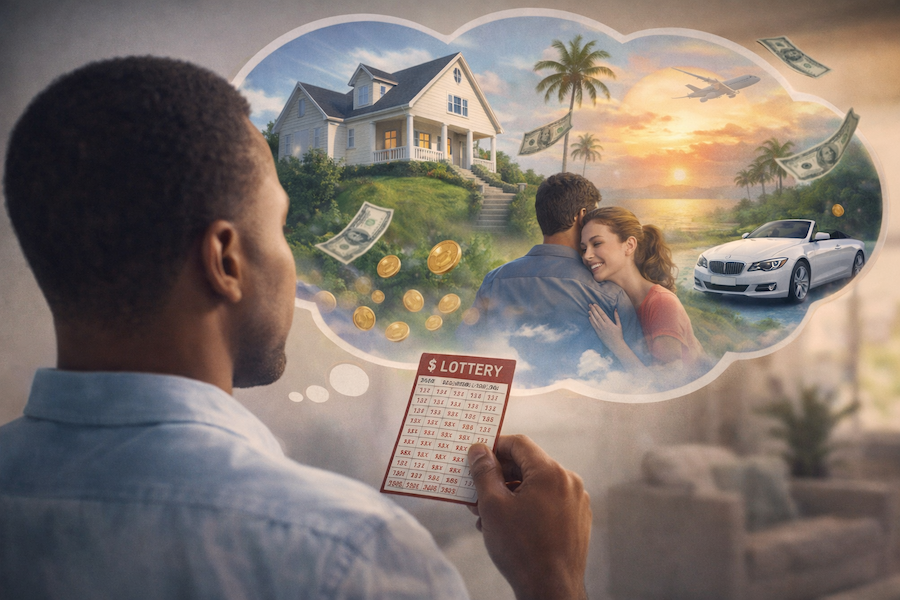
A question almost everyone has asked
At some point, many people stop and wonder:
Why do people play the lottery if the chances of winning are so low?
From a purely logical perspective, the behavior can seem contradictory.
And yet, participation continues across countries, cultures, and generations.
So the real question is not just what people do — but why it keeps making sense to them.
It’s not really a logical decision
If playing the lottery were based only on mathematics, most people would never participate.
But human decisions are rarely based on logic alone.
When someone considers playing, they are not just evaluating probabilities. They are responding to something deeper — curiosity, imagination, and the desire to momentarily step outside their current reality.
That is where the decision actually happens.
And in many cases, that decision turns into action simply because today, participating is easier and more accessible than ever.
For a moment, the future feels different
Buying a ticket does not change your present situation.
But it can change how you perceive your future.
That small action creates a window where different possibilities begin to feel real.
People start to imagine:
- what they would change
- what they would stop doing
- how their life could shift
This mental shift is not accidental. It is closely related to the anticipation people feel before results are revealed.
It begins the moment you decide to take part.
It’s about possibility, not probability
Most players understand the odds.
They do not necessarily expect to win.
What they engage with is possibility.
Probability is numerical.
Possibility is emotional.
And people naturally respond more strongly to what they can imagine than to what they can calculate.
That is why the experience continues to attract people, and why many decide to act on it, especially when access to different draws is readily available
Today, https://lottohoy.com/lotteries/ make it possible to explore different lotteries, compare options, and participate in just a few steps.
A small action with a significant mental impact
From the outside, buying a ticket is a minimal decision.
But internally, it can trigger a much larger process.
It introduces a shift in perspective — a sense that things are not entirely fixed.
That change may be temporary, but it is real.
And it is often enough to justify taking that step.
Is it irrational or simply human?
It is easy to label lottery participation as irrational.
But human behavior is not driven by numbers alone.
People make decisions based on:
- meaning
- emotion
- expectation
- personal context
From that perspective, playing the lottery is not about ignoring logic.
It is about engaging with possibility.
And when access is simple, that decision becomes even more natural.
In the end, it reflects something very human
Playing the lottery is not just about money.
It is about creating a moment where the future feels open again.
That moment may not change reality immediately.
But it can change how reality is experienced.
And sometimes, that shift is enough to move from thinking about it… to actually doing it.
FAQs
Is it irrational to play the lottery?
Not necessarily. Many people understand the odds and still choose to participate for the experience.
Do people expect to win?
Usually not. They engage more with possibility than probability.
Why does playing feel meaningful?
Because it creates a temporary sense of change and openness.
Do I need a large budget to play?
No. Many people participate with small amounts.
How can I start playing online?
You can explore platforms like LottoHoy to access different lotteries and choose how to participate.