



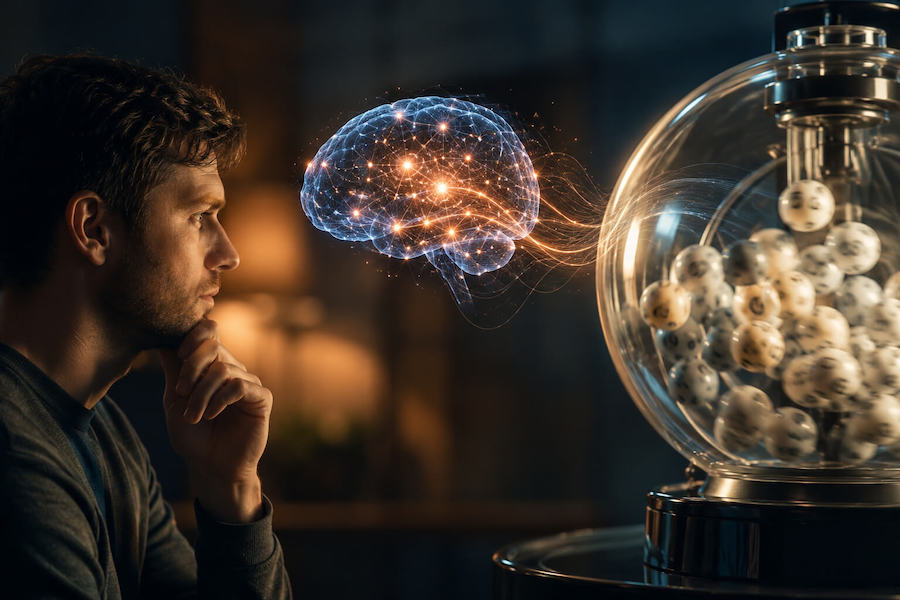
Many people claim that every number has the same probability of being drawn in a lottery. Mathematically, that is true.
However, when the time comes to choose a combination, something curious happens:
📌 Pure randomness can feel uncomfortable.
For some players, letting a machine generate automatic numbers creates a strange feeling, as if something were missing. Others prefer using important dates, anniversaries or familiar sequences even when they know this does not improve their chances.
Why does this happen?
The answer has less to do with mathematics and much more to do with how the human brain reacts to uncertainty.
Is It Normal to Feel Strange When Choosing Completely Random Numbers?
Yes.
The human brain is designed to constantly search for meaning.
From childhood, we learn to connect events, identify patterns and build stories around our decisions. That ability is useful for survival, learning and anticipating risks.
The problem is that games of chance work in exactly the opposite way:
📌 they do not need emotional logic.
When a person chooses completely random numbers, the brain perceives that there was no personal participation in the decision. That can create a subtle feeling of psychological emptiness.
Not because randomness is wrong, but because it removes the feeling of connection.
That is why many people describe automatic combinations as “cold,” “impersonal” or difficult to remember.
By contrast, numbers connected to personal experiences create something very different:
- familiarity,
- recognition,
- identity,
- and a symbolic feeling of control.
The Human Brain Hates Feeling Completely Out of Control
Many of these reactions are related to a phenomenon widely studied in behavioral psychology: the illusion of control.
The Princeton University explains how people tend to overestimate their ability to influence situations dominated by randomness and uncertainty; Princeton Psychology Department
This mechanism constantly appears in gambling, financial decisions and everyday behaviors.
There is a well known concept in psychology called the “illusion of control.”
It describes the human tendency to feel that our decisions influence random situations more than they actually do.
For example:
- throwing a die harder when we want a high number,
- choosing a specific row in a casino,
- or thinking certain numbers “feel better” than others.
Even though we rationally know probabilities do not change, emotionally the brain interprets active participation as something reassuring.
Choosing personal numbers reduces the feeling of passivity.
And that creates an important psychological effect: the experience stops feeling completely random.
This is not necessarily superstition. Often, it is simply a way to reduce the discomfort caused by having no control over the outcome.
Why Important Dates Make Us Feel Safer
In many international lotteries such as EuroMillions, Powerball or Mega Millions, millions of people continue using important dates and emotionally familiar numbers.
This does not improve the odds, but it does change the player’s psychological experience.
Personal dates constantly appear in lotteries around the world.
Birthdays. Anniversaries. Numbers related to children. Old addresses. Meaningful ages.
From a statistical perspective, these choices offer no advantage.
But emotionally they create something very powerful: psychological coherence.
📌 The brain remembers emotionally charged information more easily.
When a combination is connected to personal memories, it stops being a simple mathematical sequence. It becomes a small narrative.
And narratives create a sense of security.
Even when the outcome remains completely uncertain.
That is why many people keep using the same numbers for years.
Why Some People Distrust Automatic Numbers
Many lottery platforms offer the possibility of receiving an automatic combination, popularly known as a Quick Pick.
Mathematically, these combinations have exactly the same probabilities as any manual selection.
However, many players still prefer choosing their own numbers.
Why?
Because when choice disappears completely, part of the feeling of emotional participation disappears as well.
For some people, playing is not only about waiting for a result. It also involves feeling that there was a personal decision somewhere within the process.
That is where an interesting tension appears:
the purer randomness becomes, the more emotionally difficult it can be to accept it.
Pure Randomness Can Create Silent Anxiety
Making completely random decisions may seem simple. But for the human brain, it is not always easy.
Various behavioral studies show that people tend to prefer decisions where some level of personal participation exists, even when that participation does not change the final outcome.
Why?
Because absolute uncertainty creates cognitive tension.
The brain searches for signals. It searches for reasons. It searches for patterns.
When it finds none, an uncomfortable sensation appears that is difficult to describe.
That is why some people review an automatic combination several times before accepting it, almost as if they needed to emotionally validate numbers that should theoretically be completely neutral.
The paradox is fascinating:
📌 we know randomness has no memory, yet emotionally we continue trying to negotiate with it.
Choosing Personal Numbers Does Not Improve the Odds, But It Changes the Experience
Here it is important to separate two different things:
- mathematical probability,
- and psychological experience.
Mathematically, an automatic combination has exactly the same chances as a manually selected combination.
Emotionally, however, they do not always create the same feeling.
Understanding that difference helps people observe the game from a more conscious perspective.
For many people, the lottery is not only a statistical operation. It is also:
- imagination,
- anticipation,
- ritual,
- conversation,
- or a small mental break within daily routine.
Choosing certain numbers can become part of that symbolic experience.
The problem appears when players confuse emotional connection with mathematical advantage.
That is where many mistaken beliefs begin: mistaken beliefs
- thinking a number is “closer” to being drawn,
- believing certain combinations have special energy,
- or assuming repeating a sequence increases the chances.
Understanding how this psychological mechanism works allows people to enjoy the experience in a much more rational and balanced way.
So, Is There a Correct Way to Choose Numbers?
From a statistical perspective, no.
Every valid combination has exactly the same probability.
But from a human perspective, the answer may be different.
Some people enjoy leaving everything in the hands of randomness. Others prefer building an emotional connection with their choices.
Neither experience is necessarily wrong.
What matters is understanding what belongs to emotion and what belongs to probability.
Because when both become mixed together, the brain can start interpreting personal sensations as real mathematical signals.
And that is where many classic gambling biases related to randomness appear.
The True Psychological Value of Choosing
Curiously, many times the most important act is not winning.
It is choosing.
Choosing numbers transforms an abstract experience into something personal.
Even though the result remains unpredictable, the decision creates a feeling of participation that the brain interprets as meaningful.
And perhaps that is one of the reasons why millions of people still prefer selecting their own numbers even while knowing the probabilities never change.
Because human beings do not only search for results. They also search for meaning within uncertainty.
FAQ — Frequently Asked Questions About Choosing Random Lottery Numbers
Is It Better to Choose Automatic Lottery Numbers?
From a mathematical perspective, there is no advantage between choosing numbers manually and receiving an automatic combination.
Every valid combination has exactly the same probability.
The difference is usually psychological and emotional.
Why Do Many People Use Personal Dates?
Because numbers associated with important memories create familiarity and a feeling of emotional connection.
The human brain usually feels more comfortable when a decision has personal meaning.
Does Always Using the Same Numbers Increase the Chances?
No.
The probabilities remain the same in every draw, regardless of how many times the same combination is used.
Is It Normal to Feel Uncomfortable Using Completely Random Numbers?
Yes.
Many people experience discomfort with pure randomness because the brain naturally searches for patterns, narrative and a sense of control.
Conclusion
Feeling uncomfortable when choosing completely random numbers is more common than it seems.
It does not mean a person is irrational. It simply means the human brain is designed to search for connection, patterns and participation even in situations governed entirely by randomness.
Understanding that tendency helps people observe lottery games from a more conscious perspective, not as magical systems, but as experiences where emotion and probability constantly coexist.
And the better we understand how our mind reacts to randomness, the easier it becomes to enjoy the game in a balanced and responsible way.
Perhaps that is why pure randomness feels so uncomfortable: because even when we know everything is completely random, we still need to feel that our decisions matter somehow.