



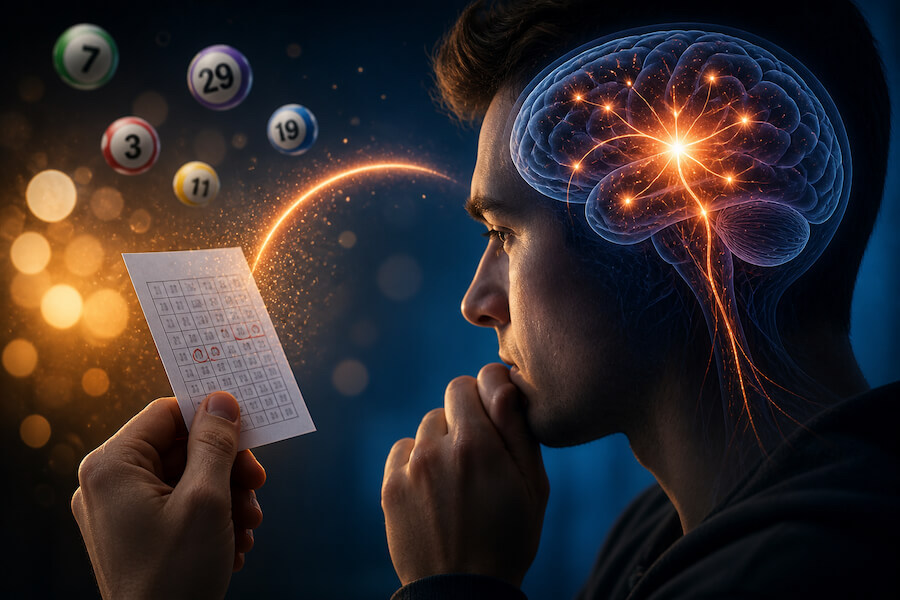
You check your ticket.
One number matches.
Then another.
For a moment, something kicks in, a mix of excitement, tension and expectation.
But it stops there.
You didn’t win.
And yet, it doesn’t feel the same as other times.
Because this time, you were “close”.
The question feels inevitable:
why does this hurt more than losing completely?
The answer is not about luck, but about how your brain interprets what just happened.
What does it really mean to be “close” to winning?
The difference between real proximity and perception
From a mathematical point of view, matching 2, 3 or even 4 numbers does not actually bring you closer to the jackpot.
Every combination has exactly the same probability.
But your brain does not work like a calculator.
It works like a storyteller.
The brain fills in stories even when they are not real
When you see partial matches, your mind builds a narrative:
“I almost got it”
“I’m close”
“I’m getting there”
Even if there is no real progress, the feeling of closeness is enough to trigger a strong emotional response.
The “almost win” effect, when the brain reacts as if you had won
What is the near miss effect
The near miss effect describes how we react when an outcome is close to success, but does not reach it.
It is not exclusive to the lottery.
It happens in games, decisions and everyday situations.
But in gambling contexts, it becomes especially powerful.
Dopamine without a full reward
When you win, your brain releases dopamine, the neurotransmitter linked to pleasure and reward.
What is surprising is that when you almost win, dopamine is also released.
But there is a key difference:
- There is no closure
- There is no full reward
- The cycle remains open
Why this feels more intense than clearly losing
Losing without matching any numbers creates a simple response:
quick closure, emotional detachment
But almost winning creates tension:
- There was emotional activation
- There was expectation
- But there was no resolution
This combination is psychologically much stronger.
Why matching some numbers feels so important
The illusion of progress
When you match several numbers, your brain interprets it as moving toward a goal.
Even if it is not true statistically, it feels like progress.
Confirmation bias
We tend to remember what matches our expectations.
That is why:
- You remember the numbers you got right
- You ignore the ones that did not match
This reinforces the feeling of being close.
The trap of patterns
Dates, repeated numbers, familiar combinations
The brain looks for order even in completely random systems.
And when it finds partial matches, it treats them as signals.
Why “almost winning” makes you want to play again
Intermittent reinforcement
One of the most studied mechanisms in human behavior.
Not knowing when a reward will come makes the search more intense.
Almost winning acts as reinforcement:
- It is not a victory
- But it is not a clear loss either
The brain wants to close the loop
When something is incomplete, it creates internal tension.
The brain wants to resolve it.
In this context, the simplest way is to try again.
Motivation and frustration, a powerful mix
Almost winning creates two opposite forces:
- Frustration, I didn’t win
- Motivation, I was close
Together, they generate energy that pushes you to repeat the action.
It is not weakness, it is how the brain works
We are all susceptible
This is not a personal flaw.
It is a common pattern in how humans process:
- rewards
- expectations
- uncertainty
Understanding it changes the experience
When you recognize this mechanism, something important happens:
You stop seeing “almost” as an external signal
And start seeing it as an internal reaction
This does not remove the emotion, but it makes it more conscious.
The role of a more mindful experience
Playing does not have to be impulsive.
It can be an experience where:
- you understand what you feel
- you recognize the mechanisms
- you make clearer decisions
That is where your relationship with the game changes.
Frequently asked questions
Is it normal to feel frustrated when you almost win the lottery?
Yes. It is a natural response to an incomplete reward.
Does being close increase my chances next time?
No. Each draw is independent. The feeling of closeness does not affect probability.
Why do I remember near wins more than losses?
Because they carry stronger emotional weight. The brain prioritizes intense reward signals.
Is the “almost win” effect designed into games?
Not necessarily in traditional lottery games, but the brain interprets any partial match as meaningful, even if it is random.
Conclusion
You were not actually closer to winning.
But your brain experienced it as if you were.
That gap between reality and perception is what makes almost winning feel so intense.
Understanding it does not remove the emotion.
But it transforms it.
Because when you know what is happening inside you, the experience stops being automatic and becomes conscious.