



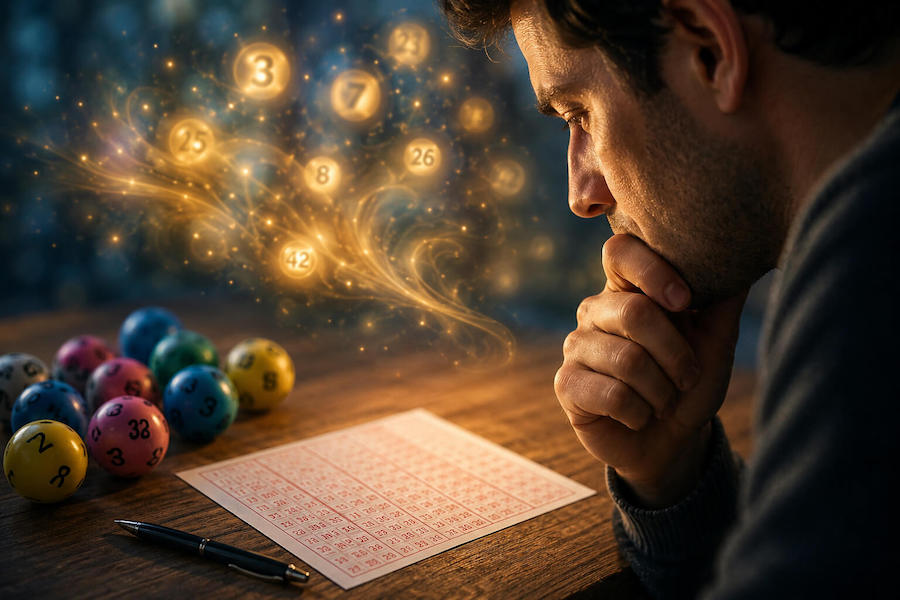
Some people change their lottery combination every draw.
Others have been playing the exact same numbers for years.
Birthdays.
Anniversaries.
“Special” numbers.
Combinations that somehow feel personal.
It is an interesting question because lotteries are completely random.
The odds do not change because you use a birthday, a favorite number or a repeated combination.
So why do so many people keep doing it?
The answer has less to do with mathematics and much more with how the human brain reacts to uncertainty.
In fact, this emotional connection appears even before the draw itself, during the moment when the brain already starts anticipating possibilities and rewards.
If you want to better understand that previous stage, you can also read our article about what happens in your brain right before checking a lottery ticket
Why the Brain Looks for Patterns Even in Randomness
Humans are designed to find meaning
The human brain evolved to detect patterns.
For thousands of years, recognizing signals in the environment improved survival chances:
- identifying routes,
- predicting danger,
- anticipating behavior.
The problem is that this mechanism still works even when the environment is completely random.
And lotteries are one of the clearest examples of pure chance.
Absolute randomness feels uncomfortable
The human mind does not feel comfortable with total chaos.
That is why we try to introduce small structures:
- routines,
- rituals,
- repeated combinations,
- familiar numbers.
Choosing certain numbers does not change the odds.
But it does change how we experience the game.
Why Many People Use Birthdays and Personal Numbers
Numbers also carry emotional meaning
Not all numbers feel the same to us.
Some are connected to:
- important people,
- memories,
- happy moments,
- meaningful events.
That is why so many people play:
- birth dates,
- anniversaries,
- numbers connected to family members.
Not necessarily because they believe those numbers will win, but because they create emotional connection.
Choosing numbers is also part of identity
Many people talk about:
- “my number”
- “my combination”
- “the usual numbers”
This happens because the brain turns certain numbers into personal symbols.
And the more we repeat a combination, the more familiar and meaningful it becomes.
The brain remembers emotional things better than random ones
Emotions strengthen memory.
That is why we remember much more easily:
- a number connected to someone important,
- a special date,
- or an emotional coincidence,
than a completely random combination.
The Illusion of Control: Feeling Like We Decide Something Inside Randomness
Choosing numbers creates participation
There is a huge psychological difference between:
- receiving automatic numbers,
- and choosing them personally.
When we choose, we feel actively involved in the experience.
Even if the odds do not change, the emotional perception does.
Emotional control vs real control
Choosing numbers does not alter randomness.
But it partially reduces the feeling of uncertainty.
And that matters because the human brain needs some sense of control, even in unpredictable situations.
Repeating combinations creates psychological security
Repetition creates familiarity.
And familiarity creates comfort.
That is why many people keep the exact same numbers for years, even knowing there is no mathematical advantage.
Why It Is So Hard to Change Numbers
The fear of missing out “that exact day”
This is where one of the strongest psychological mechanisms appears:
“What if I change my numbers and they come out right now?”
That thought creates enormous emotional tension.
The brain avoids breaking emotional habits
When a combination has been with us for years, stopping its use feels uncomfortable.
Not because the numbers have better odds, but because the brain interprets the change as a possible future loss.
Near misses also influence our decisions
Many times, matching a few numbers strengthens the emotional attachment even more.
That feeling is closely related to the so called where the brain interprets a partial coincidence as much more meaningful than it really is.
Choosing Numbers Does Not Change Randomness, but It Changes the Experience
The game is also emotional
Lottery is never only mathematics.
It is also:
- excitement,
- participation,
- anticipation,
- emotional connection.
And choosing numbers is part of that human experience.
Understanding this changes the way we play
Understanding how the brain works does not remove emotion.
But it helps us experience it more consciously.
The difference matters:
- one thing is enjoying the ritual,
- another is believing there is real control over randomness.
Between entertainment and magical thinking
We all search for meaning in things that emotionally affect us.
And numbers, even if objectively random, can become deeply personal symbols.
Maybe that is why so many people keep playing the same combination:
because they are not just numbers.
They are stories.
Frequently Asked Questions
Is it normal to always play the same lottery numbers?
Yes. Many people develop emotional attachment to certain numbers, especially important dates or combinations connected to personal memories.
Do personal numbers increase winning odds?
No. Every combination has exactly the same probability of being drawn.
Why do some numbers feel like they represent us?
Because the human brain associates emotions and memories with familiar symbols, including repeated numbers.
What happens if I change my numbers and the old ones win?
That fear is related to anticipated regret bias, where the brain tries to avoid the feeling of missing an important opportunity.
Why do many people use birthdays in the lottery?
Because dates carry emotional meaning and create a sense of personal connection with the chosen combination.
In Conclusion
Most people do not choose numbers randomly.
They choose memories.
Dates.
People.
Moments.
Because even inside a completely random system, the human brain still needs connection, identity and some sense of control.
And maybe that is one of the reasons why playing the lottery is never only about numbers.